
Homepage

Showing posts with label Soil Management. Show all posts
Showing posts with label Soil Management. Show all posts
Soil pH
Soil pH is referred to as the acidity of the soil and is measured by the number of Hydrogen ions present in the soil .
When the soil pH is too acidic (low pH) or alkaline (high pH), nutrients present in the soil become locked-up or unavailable. Correcting the pH has the same effect as applying fertilizer as it unlocks plant nutrients already present, and it is more cost effective as well.
Some garden plants thrive in acidic soils while others prefer an alkaline soil. The acidity or alkalinity of soil is measured by pH (potential Hydrogen ions). pH is a measure of the amount of lime (calcium) contained in your soil, and the type of soil that you have.
A soil with a pH lower than 7.0 is an acidic soil and one with a pH higher than 7.0 is alkaline.
Adjusting Soil pH
To raise or lower the pH level in the soil either Limestone or Sulfur is utilized. There are other materials that will do the job also, but the aforementioned are the most widely used.
Limestone is added to soil raise the pH level because limestone is essentially calcium and calcium reacts with water in the soil to yield hydroxyl ions .. a process known as, hydrolysis... thus the pH level in the soil is raised.
Sulfur reacts with bacteria in the soil and produces sulfuric acid, which releases hydrogen ions thus causing the soil to become more acidic..... the pH level is lowered.
Application Of Lime (To Raise Soil pH)
To increase your pH by 1.0 point and make your soil more alkaline.
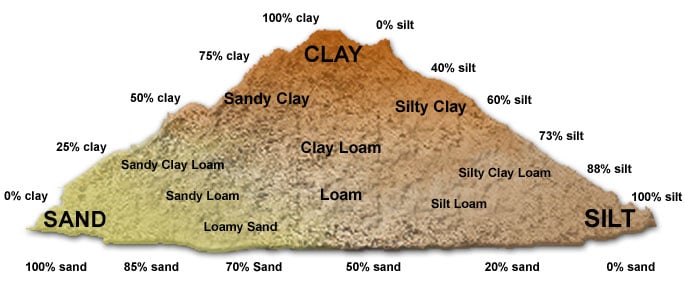
Add 4 ounces of hydrated lime per square yard in sandy soils
Add 8 ounces of hydrated lime per square yard in loamy soils
Add 12 ounces of hydrated lime per square yard in clay soils
Add 25 ounces of hydrated lime per square yard in peaty soils
The addition of ash, bone meal, or crushed oyster shells will also help to raise soil pH levels.
Application of Sulfur (To Lower Soil pH)
If your soil needs to be more acidic, sulfur may be used to lower the pH if it is available.
To reduce the soil pH by 1.0 point
Mix in 1.2 oz of Garden Sulfur per square yard if the soil is sandy
Mix in 3.6 oz per square yard for all other soils.
Composted leaves, wood chips, sawdust, leaf mold and peat moss, will also help to lower the soil pH.



Soil Enrichment Methods
Method 1 (18 Kgs / Acre)
List of seeds used to restore soil fertility.
Pasunthaal (Green Manure Seeds) - 4 Kgs
Sanappu (Sunhemp) - 1Kg
Thakkaipoondu (Daincha) - 1 Kg
Avuri (Indigo) - 1 Kg
Sesbania (Sesbania) - 1 Kg
Siruthaaniam (Millet Seeds) - 4 Kgs
Cholam (Cholam) - 1 Kg
Cumbu (Spiked Millet) - 1 Kg
Kelvaragu (Ragi) - 1 Kg
Samai (Samai) - 1 Kg
Payaru (Cereal Seeds) - 4 Kgs
Ulundu (Blackgram) - 1 Kg
Pacchapayaru (Greengram) - 1 Kg
Karamani (Cowpea) - 1 Kg
Thuvarai (Redgram) - 1 Kg
Ennai (Oil Seeds) - 4 Kgs
Verkkadalai (Groundnut) - 2 Kgs
Ell (Gingely) - 0.5 Kg
Amanakku (Castor) - 1 Kg
Soya Mochai (Soya Beans) - 0.5 Kg
Vaasanai (Perfume Seeds) - 2 Kgs
Thaniya (Coriander) - 1 Kg
Kadukku (Mustard) - 0.5 Kg
Venthayam (Fenugreek) - 0.25 Kg
Sombhu (Jeera) - 0.25 Kg
The land has to be tilled for 1 or 2 times before the seeds are broadcasted.
The above 20 seeds mentioned need to be mixed thoroughly and broadcasted by hand.
Just before flowering of the crops(in 3 months time), the crops need to be dealt in two different ways.
If the land is slushy, the entire crops need to be tilled again so that the crops as well as the soil are mixed throughly and allowed to decompose.
If the land is not slusy, the entire crops need to be cut at the base and allowed to decompose in the soil.
Mostly these needs to be done before the main crop is grown or if you are not growing any main crop and just for soil improvement, it is better to do this during the rainy season.
Method 2 (Green Manures List)
The following Green Manures can be applied to improve the soil fertility.
Agathi - Sesbania grandiflora
Avuri - Indofera tinctoria
Adhatoda - Adhatoda zeylanica Medicus
Avaram - Cassia auriculate
Otiyan - Lannea coromandelica
Erukku - Calotropis gigantean
Kattukottai - Jatropha curcase
Kattukolunchi - Tephrosia purpurea
Sanaappu - Crotalaria juncea
Seemai Agathi - Cassia alata
Toyya-k-kirai - Digera muricata
Cen-kitai or Malai Murungai - Sesbania bispinosa
Thumbai - Leucas aspera
Nalvelai - Cleome gynandra
Naivelai - Cleome viscosa
Nattu Cavundal - Leucaena leucocephala
Nochi - Vitex negundo
Nuna - Morinda coreia
Pannaipoo - Celosia argentea
Peyavirai - Cassia occidentalis
Pungam - Pongamia pinnata
Poovarasu - Thespesia populnea
Nilavirai - Cassia senna
Malai Vembu - Melia azedarach
Murungai - Moringa oleifera
Rail Poondu - Croton bonplandianus
Baillon Vaagai - Alibizia lebbeck
Vadanarayanan - Delonix elata
Vembu - Azadirachta indica
Subscribe to:
Posts (Atom)